
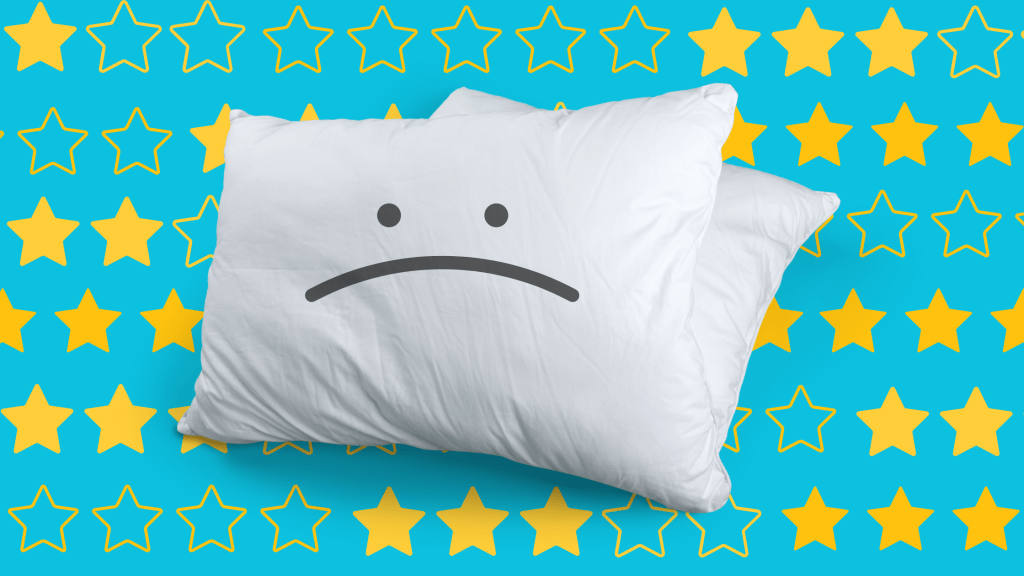
What’s the stupidest thing you’ve ever read user reviews for?
Mine’s gotta be pillowcases.
Spending any amount of time reading reviews of pillowcases is objectively deranged. Though, is it as deranged as writing user reviews of pillowcases? Jury’s out. The point is, the fact that I spent any time at all (it was like 45 minutes) reading reviews of something so inconsequential is behavior I wouldn’t have even considered without the modern internet’s promise of finding exactly what you need if only you search.
I do realize that there are people who legitimately need reviews of mundane items so they can live comfortably. But the notion that everyone needs to be assured that every purchase we’re making or experience we’re having is vetted to the gills and deemed The Best is on its face absurd. Andy Daly nailed it with Review ten years ago, honestly. The reality is that whatever pillowcase Target has in stock for mostly cheap when I go there is fine for the likes of me and probably the likes of you, too. (Again: 45 fuckin’ minutes reading pillowcase reviews. Sorry, Mary Oliver.)
But this isn’t about user reviews of things. This is about trying to articulate a gut feeling that things are generally kinda bad across the board in part because of a culture of competitive consumerism that we’re all stuck in. Capitalism, sure. But not just capitalism. It’s optimized capitalism.
Optimize Your Way to a Perfect Life
Once you notice how much “optimization” as a concept has permeated the culture it’s kind of hard to ignore. It feels relentless.
Businesses want to “optimize operations,” which generally means finding ways to make everyone use a new software program they “implemented” to track micro-productivity. Those scanners big box stores and warehouse employees use to find the thing you ordered and get it to you fast? They’re configured to scan faster, more accurately, and so on, so the person holding it can do more work in less time. An exhausting way to go about the day.
Tech bros love to promise “optimization” as one of the benefits of whatever new screen they’re waving at us at any given time. Or embedding in vehicles. (Can we please regulate this out of existence soon? Thanks.) Optimize your home by using light bulbs you have to turn on and off with an app on your phone.
Regular people want to optimize how we treat our bodies, how we feed and move them, how we raise our kids, decorate our homes, or choose pillowcases…all of it in pursuit of the best life experience possible.
All this optimization is supposed to make things better. Easier. More of what makes us happy, delivered to us faster and with fewer hassles than ever before.
But what’s easier than flicking a light switch?

Optimization culture is the promise of better living through capitalism and nothing more. Use the AR vacuum up there and your house will be cleaner, healthier, and more perfect than ever before. Use a fitness app to make “data-driven decisions” about what you eat and when you sleep and how you move and you will become The Perfect You. Get stats from your grammar checker delivered to your inbox to motivate you for…reasons?
Of course, none of it is actually about you enjoying your life, really. How can you when you’re yelling at your phone to pair with your vacuum for fuck’s sake? It’s all about businesses making the most money as efficiently as possible. (It’s no wonder generative AI is the current darling of the LinkedIn-brained business class.)
When Does Optimization Become Cultural Monotony?
One of my favorite Guided By Voices songs to chug a beer and hop around to is Exit Flagger. One of the lines is “I need a life of sameness” (I’m pretty sure. It’s a little mumbly) and it gets stuck in my head a lot these days.
I’ve been thinking about it lately in light of the optimization of everything. The example I go to lately is the cancellation of my beloved gay pirate show (Our Flag Means Death, go stream it now please and thanks), and a slew of other shows and films made by people who aren’t the usual suspects (straight white dudes), or don’t fit into neat genres. To hear him tell it, the brain genius in charge over at whatever HBO is calling itself now, David Zaslav, is simply making business decisions to optimize budgets and drive profit (it’s not going great, but that’s another story). The best way to do that, according to his Business Logic, is to invest in known quantities over new, unproven ideas. It’s why that transphobic British lady in her castle gets a huge payout and another show — just need to refine some old and still inexplicably beloved characters and voila!
Optimization culture only rewards itself.
David Zaslav’s attempts at streamlining a company may be running it directly into the ground while spewing out middling crap, but he’ll still get several bajillion dollars so what does he care? Businesses using generative AI to churn out more content don’t care if it’s good. They care if it’s effective and that means more keyword-optimized slop for the glop machine that is the internet.
Meanwhile, we’re stuck wading through it all as we search for the pillowcase that will finally fix everything.
This was particularly rambly so thanks for reading if you got this far. See ya next time.
 Home
Home 